

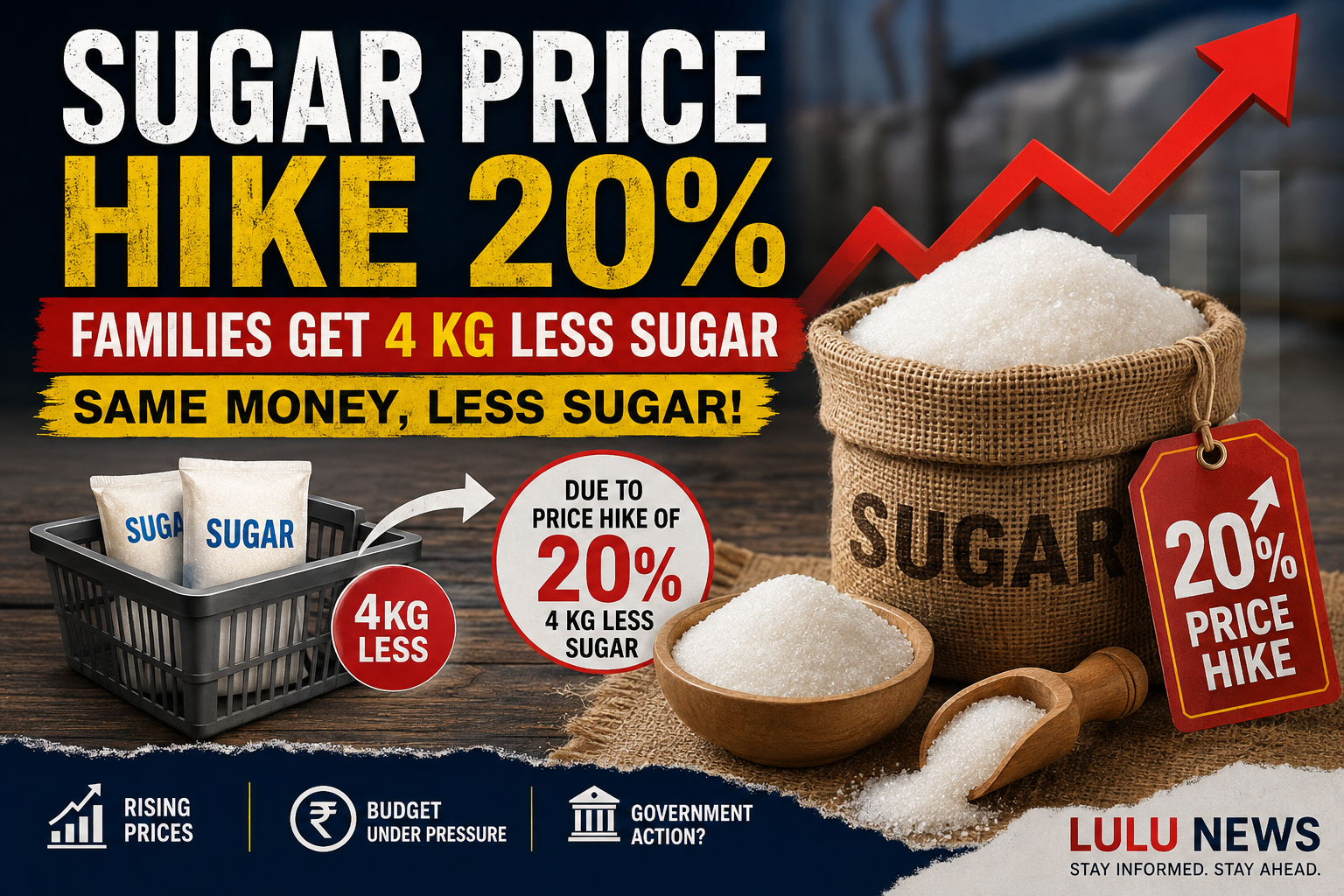
The latest sugar price hike in India has turned an everyday kitchen essential into a growing concern for households, sweet shops and food businesses. With retail prices rising sharply ahead of the festive season, consumers are now asking a simple question: how much less can the same amount of money actually buy?
The search phrase “due to price hike of 20%, 4 kg less sugar” perfectly captures the basic economic problem behind a price surge. When the price of an essential commodity rises significantly while the household budget remains the same, consumers naturally have to reduce the quantity they purchase.
Recent reports show that sugar prices have increased by around 20% in some markets over a short period. In Kolkata, retail sugar prices have reportedly climbed by around ₹20 per kg in a month, reaching nearly ₹70 per kg.
Sugar Price Hike: The Same Money, Less Sugar
For an ordinary family, the problem is not simply that sugar has become expensive. The bigger issue is that the same monthly grocery budget now buys less.
Suppose a family has a fixed amount of money for groceries. If sugar becomes 20% more expensive, the family either has to spend more money or reduce the quantity purchased.
This is basic purchasing-power mathematics, but in real life it means fewer kilograms of sugar in the kitchen, higher costs for homemade sweets and an even bigger grocery bill during the festive season.
That is why the phrase “due to price hike of 20%, 4 kg less sugar” has become relevant from a consumer perspective. A percentage increase may look small on paper, but its impact becomes very real when it affects an essential product bought regularly.
Why Has Sugar Become So Expensive?
Several factors are being cited for the recent rise in sugar prices.
Lower-than-expected domestic production, weather-related damage to sugarcane crops, rising festive demand, tighter global supplies and market speculation have all been identified as factors behind the price increase. The government has also rejected the argument that ethanol diversion alone is responsible for the current surge.
The festive calendar is another major factor.
Ganesh Chaturthi, Dussehra and Diwali are approaching, and demand for sugar traditionally rises during this period because of increased consumption of sweets, bakery products and other food items.
In other words, the market is facing the classic problem of higher demand meeting tighter supply.
Is the Government Responding Too Late?
This is where the debate becomes politically uncomfortable.
The government has now stepped in with measures aimed at increasing supply and controlling prices. India has allowed duty-free imports of 1 million metric tonnes of raw sugar until October 31, 2026, a move intended to increase domestic availability and cool prices.
But consumers are entitled to ask a reasonable question:
If the government knew that domestic sugar availability was tightening and the festive season was approaching, why did stronger intervention come only after prices had already jumped?
That does not automatically mean the government caused the price rise. However, the timing of policy intervention can certainly be questioned.
For families already dealing with rising food expenses, waiting for prices to become a problem before announcing corrective measures offers little immediate comfort.
Government Blames Multiple Factors, But Consumers Pay the Bill
The government’s explanation points toward lower production, weather problems, festive demand, global supply conditions, speculation and hoarding.
These factors may explain the market situation, but from a consumer’s perspective, the final result is much simpler:
The grocery bill goes up.
Whether the reason is bad weather, lower production, market speculation or supply management, the person standing at the retail counter still has to pay the higher price.
And that is where the frustration begins.
Consumers do not buy government explanations at the grocery store. They buy sugar, rice, flour and vegetables—and they pay whatever price is written on the bill.
20% Price Rise Means a Real Cut in Household Purchasing Power
A 20% increase in the price of an essential item effectively reduces what a fixed budget can purchase.
For example, if a consumer previously spent ₹1,000 on sugar at a lower price, a 20% increase means the same ₹1,000 will purchase significantly less sugar.
The impact becomes even more noticeable for businesses.
Sweet shops, bakeries, restaurants, beverage manufacturers and food-processing companies purchase sugar in much larger quantities. Higher input costs can eventually be passed on to customers through higher prices.
So the sugar price hike may not remain limited to the sugar packet sitting in your kitchen.
It can potentially affect the price of sweets, cakes, biscuits, beverages and several other products.
Why the Festive Season Could Make Things Worse
India’s festive season is traditionally a high-demand period for sugar.
From homemade sweets to large-scale mithai production, sugar consumption increases significantly.
If supply remains tight while demand rises, prices could face additional pressure.
This is precisely why the government’s decision to allow duty-free imports is important. But imports do not instantly appear on retail shelves. Logistics, refining, distribution and market conditions all determine how quickly additional supply can reach consumers. Reuters reported that some imported supplies could take time to arrive, with larger shipments expected closer to October.
So consumers may have to wait before feeling any meaningful relief.
Government Cuts Stock Limits to Stop Hoarding
The Centre has also tightened stockholding rules for bulk sugar consumers.
From September 1 to November 30, 2026, bulk users consuming more than 10 metric tonnes of sugar per month will be restricted to holding only 15 days’ worth of inventory. The government says such measures are intended to prevent excessive stocking and maintain market availability.
This could help prevent artificial shortages.
But again, the bigger question is whether these measures will actually translate into lower retail prices for ordinary consumers.
That answer will depend on how quickly supply improves and whether market prices begin to cool.
What Does the Sugar Price Hike Mean for Common People?
For middle-class and lower-income households, every price increase matters.
A few rupees more for sugar may not look dramatic when considered separately. But combine it with higher prices for vegetables, cooking oil, pulses, milk and other essentials, and the monthly grocery budget can become increasingly difficult to manage.
The real issue is therefore not just “How expensive is sugar?”
The bigger issue is:
“How much less can a family buy with the same income?”
That is the real story behind the phrase “due to price hike of 20%, 4 kg less sugar.”
Will Sugar Prices Come Down?
The government’s duty-free import decision could increase supply and help cool the market. The reduced stockholding limit could also discourage hoarding.
However, prices will ultimately depend on several factors, including domestic production, imports, festive demand, global sugar prices and market behaviour.
At this point, it would be premature to promise consumers an immediate fall in prices.
The government has taken steps, but consumers will judge those steps by one thing: the price they see at the shop.
The Bigger Problem: Essential Food Inflation
The sugar price story is also a reminder of how quickly an essential commodity can affect household budgets.
When an item used in tea, sweets, desserts and countless processed foods becomes expensive, the impact spreads across the food economy.
The government can announce imports, stock limits and monitoring measures, but long-term price stability requires better supply planning and timely intervention.
Waiting until prices hit uncomfortable levels and then trying to cool the market can create unnecessary pressure on consumers.
Final Word
The latest sugar price hike is more than just another market headline. It is a direct example of how inflation can quietly reduce household purchasing power.
When prices rise by around 20%, the same budget buys less. And for families working with fixed monthly incomes, that means cutting quantities, changing shopping habits or spending more.
The government’s decision to allow 1 million tonnes of duty-free raw sugar imports and impose tighter stock limits shows that authorities are taking the situation seriously.
But the public has every reason to ask whether these measures came early enough.
Because ultimately, consumers are not interested only in policy announcements. They want to know one thing:
When they walk into a shop tomorrow, will sugar finally become cheaper—or will the grocery bill keep getting sweeter for the market and more bitter for the common household?
FAQs
What does “due to price hike of 20%, 4 kg less sugar” mean?
The phrase describes how a 20% increase in sugar prices can reduce the quantity a consumer can purchase with the same fixed amount of money. It highlights the loss of purchasing power caused by inflation.
Why are sugar prices increasing in India?
Recent reports point to lower-than-expected domestic production, weather-related crop issues, festive demand, tighter global supplies and speculation or hoarding among the factors affecting prices.
Has the Indian government taken action against rising sugar prices?
Yes. The government has allowed duty-free imports of up to 1 million tonnes of raw sugar and has also tightened stockholding limits for bulk consumers.
Will sugar prices fall soon?
Prices could ease if additional supplies reach the domestic market and festive demand is adequately met. However, the timing and size of any decline cannot be guaranteed.
How does a sugar price increase affect other products?
Higher sugar costs can increase production expenses for sweets, bakery products, beverages and other processed foods. Businesses may absorb some costs or pass them on to consumers.
📢 Stay Updated with Lulu News
Don’t miss the latest breaking news, trending stories, business updates, entertainment news, politics, sports and viral stories from India and around the world.
👉 Follow and subscribe to Lulu News for quick, reliable and easy-to-understand news updates delivered straight to you.
Stay informed. Stay ahead. Stay connected with Lulu News! 📰✨
🌐 Visit: Lulu News














Leave a Reply